Guide to Reading Supplement Labels for Gummy Vitamins 2026
How to Read Supplement Labels: A Complete Guide to Choosing Quality Gummy Vitamins in 2026
What You'll Learn: How to decode the Supplement Facts panel, identify third-party certifications, spot red flags in ingredient lists, and confidently choose a high-quality gummy vitamin — without falling for marketing hype.
With 57.6% of US adults using dietary supplements and the global market reaching $218.88 billion in 2026 (Precedence Research), the supplement aisle has never been more crowded — or more confusing. Flashy packaging, bold health claims, and proprietary blends can make it nearly impossible to tell a high-quality product from an overpriced one. But here's the truth: once you know how to read a supplement label, you can cut through the noise in under 60 seconds. This guide walks you through exactly what to look for — with practical examples using real gummy vitamin labels.
Step 1: Start with the Supplement Facts Panel
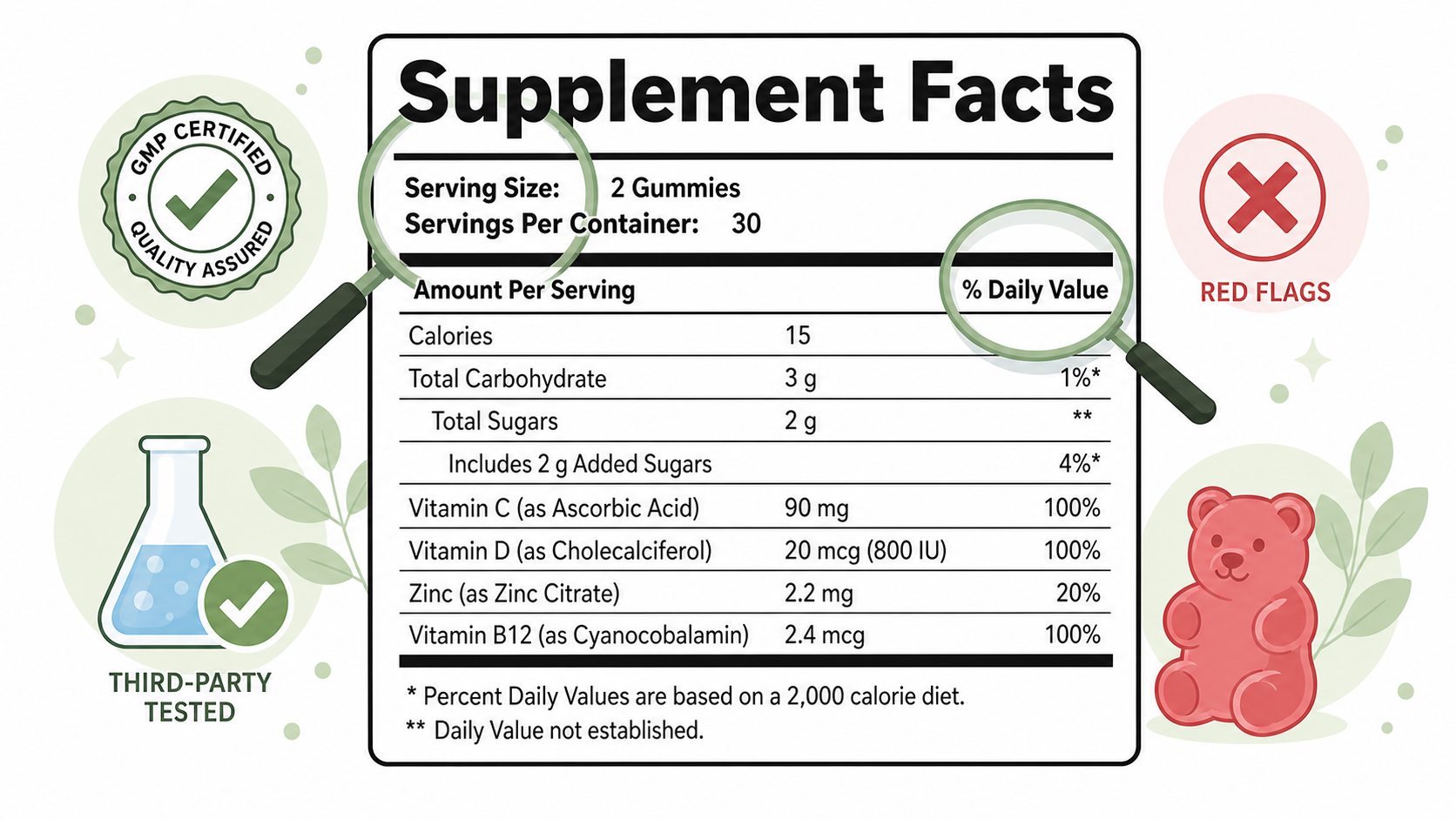
Every dietary supplement is required by the FDA to display a "Supplement Facts" panel — usually on the back of the bottle or box. This is the single most important source of truth on any supplement. Ignore the marketing claims on the front. The Supplement Facts panel tells you what's actually inside.
Key sections of the panel:
- Serving Size: Tells you how many gummies (or capsules, or scoops) count as one serving
- Servings Per Container: How many total servings are in the package — divide the total count by serving size
- Amount Per Serving: The actual quantity of each nutrient or ingredient in one serving
- % Daily Value (%DV): How much of your daily need one serving provides (based on a standard 2,000-calorie diet)
Step 2: Check Serving Size — This Is Where Products Hide
This is the most common trick in the supplement industry. A product might list "Vitamin D: 100% DV" — but only if you take 4 gummies. If the serving size says 4 gummies and you only take 2, you're getting 50% DV, not 100%.
Real example: Goli Supergreens Gummies list 2 gummies per serving but recommend taking them twice daily — meaning a full day's serving is actually 4 gummies. If you only take 2, you're getting half the labeled dose.
Compare to: Grüns Daily Nutrition Gummies clearly state 1 pack (8 gummies) as one serving, once daily. What you see is what you get — no hidden math required.
What to do: Always check the serving size first. Calculate how many gummies you'll actually take per day and adjust the %DV accordingly.
Step 3: Look at % Daily Value (%DV)
%DV tells you how much of each nutrient is in one serving relative to the average adult's daily need. Here's the quick guide:
- 100% DV = Full daily coverage for that nutrient
- 20% DV or more = High source
- 5% DV or less = Low source (essentially a token amount)
What this means for gummy vitamins: A quality daily nutrition gummy should provide at least 100% DV for most essential vitamins (A, C, D3, E, B6, B12, thiamine, riboflavin, niacin, folate, biotin, pantothenic acid). If a product shows low %DV across the board, it's not providing meaningful nutrition — you're essentially paying for sugar and flavoring.
| %DV | What It Means | Example |
|---|---|---|
| 100%+ | Full daily coverage — excellent | Grüns provides 100% DV of 12 vitamins |
| 25-99% | Good supplemental amount | Useful for minerals where 100% isn't practical |
| 5-24% | Low — token amount | Better than nothing but won't correct deficiencies |
| 0% or not listed | No meaningful amount | This nutrient is absent from the product |
Step 4: Decode the Ingredients List
Ingredients are listed in descending order by weight. The first ingredient is the most abundant. For gummy vitamins, the first few ingredients are usually sweeteners and base (sugar, tapioca syrup, pectin).
Green flags:
- Named forms of nutrients (e.g., "methylcobalamin" instead of just "Vitamin B12", "folate as calcium L-methylfolate")
- Natural colors from fruit/vegetable juice (not Red 40, Blue 1)
- Natural flavors, not artificial
- Pectin (plant-based) instead of gelatin
- Organic or non-GMO ingredients
Red flags:
- "Proprietary blend" without listing individual amounts — this hides exactly how much of each ingredient you're getting
- Artificial colors (FD&C Red No. 40, Blue No. 1, Yellow No. 5)
- High-fructose corn syrup or hydrogenated oils
- Magnesium stearate or titanium dioxide (unnecessary fillers)
- Vitamin D2 instead of D3 (D3 is more bioavailable)
Step 5: Look for Third-Party Certifications
This is your best shortcut to quality. Third-party certification means an independent organization has verified the product's purity, potency, and manufacturing quality.
Certifications to Know
| Certification | What It Means | Who Should Care |
|---|---|---|
| NSF Certified | Product tested for label accuracy, contaminants, and manufactured in GMP-compliant facility | Anyone wanting rigorous independent verification |
| USP Verified | Product meets USP standards for purity, potency, and manufacturing | Those who want product-level certification |
| GMP (NSF or FDA-registered) | Facility follows Good Manufacturing Practice regulations | Basic quality baseline — all quality supplements should meet this |
| Non-GMO Project Verified | Product contains no genetically modified ingredients | Those avoiding GMOs |
| USDA Organic | Product contains at least 95% organic ingredients | Those prioritizing organic sourcing |
Important distinction: "Manufactured in a GMP-certified facility" (facility-level) is not the same as "NSF Certified" or "USP Verified" (product-level). Facility-level GMP is good; product-level certification is better. Grüns, for example, is manufactured in NSF-, GMP-, and FDA-certified facilities with documented third-party testing for heavy metals and contaminants.
Step 6: Check for Red Flags
Beyond the label, watch for these warning signs:
- Vague health claims. "Supports immunity" is fine. "Cures disease" or "Clinically proven" without a named study is illegal and a major red flag.
- No Supplement Facts panel. If you can't see the full ingredient disclosure on the website before buying, be suspicious.
- No third-party testing disclosure. Quality brands are proud of their testing — they'll tell you who tested and what they found.
- Unrealistically low price. A multivitamin that costs $0.10/day probably uses the cheapest, least absorbable forms of nutrients — if it has meaningful amounts at all.
- No customer service or return policy. Quality brands stand behind their products.
Step 7: Apply This Knowledge to Gummy Vitamins
Gummy vitamins have unique considerations compared to pills:
- Sugar content: Gummies need sweeteners. Quality brands offer sugar-free options (allulose, monk fruit, Reb M). Check the "Added Sugars" line on the label.
- Heat sensitivity: Gummies can melt or degrade above 77°F (25°C). Quality packaging (individual sealed packs) protects against this.
- Pectin vs. gelatin: Pectin (plant-based) is vegan-friendly and generally cleaner. Gelatin (animal-derived) is traditional but may contain additives.
- Nutrient stability: Some vitamins (C, B vitamins) are more stable in gummy form than others. Quality brands test for nutrient retention throughout shelf life.
Quick Reference: Label Reading Checklist
Use this 60-second checklist before buying any gummy vitamin:
- ☐ Serving size clearly stated and realistic (not hiding behind "take 4 gummies")
- ☐ %DV of 100% or more for at least 8-10 essential vitamins
- ☐ Named, bioavailable forms of nutrients (methylcobalamin, NOT cyanocobalamin)
- ☐ No artificial colors (No Red 40, Blue 1, Yellow 5)
- ☐ Third-party certification disclosed (NSF, USP, GMP)
- ☐ Sugar-free or low-sugar option available
- ☐ Pectin-based (vegan, no gelatin)
- ☐ Money-back guarantee (at least 30 days)
- ☐ No proprietary blends hiding ingredient amounts
- ☐ Clear storage instructions (cool, dry place)
Frequently Asked Questions
What's the difference between "proprietary blend" and regular ingredients?
A proprietary blend lists combined ingredients without showing individual amounts. This means you know what's inside but not how much. Quality supplements usually disclose individual amounts for key active ingredients.
Are gummy vitamins tested the same way as pills?
Yes — the same testing standards (NSF, USP, GMP) apply regardless of format. The key is whether the manufacturer actually submits their products for third-party testing. Many gummy brands do not.
How do I know if a supplement is "third-party tested"?
Look for certification seals (NSF, USP, Informed-Sport, ConsumerLab) on the product page or packaging. If a brand claims third-party testing but doesn't show a seal, ask which lab performed the testing.
Should I avoid supplements with "proprietary blends"?
Not always — but be cautious. If a brand uses a proprietary blend, they should still disclose total dosage of the blend and list the included ingredients. Be skeptical of blends that group active ingredients with "filler" herbs or nutrients.
Do I need to worry about heavy metals in gummy vitamins?
Heavy metal contamination is a legitimate concern in all supplements, including gummies. Look for brands that specifically state they test for heavy metals and publish results. Grüns, for example, includes heavy metal and contaminant testing as part of their third-party quality program.
Conclusion
Reading a supplement label is a skill — and once you've learned it, you'll never look at the supplement aisle the same way again. Focus on the Supplement Facts panel, not the front-of-package marketing. Check serving size first. Look for meaningful %DV values. Seek out third-party certification seals. And don't be afraid to contact a brand directly if their testing transparency isn't clear.
The best gummy vitamin is one that delivers what it promises, in forms your body can actually use, from a manufacturer that's willing to prove it through independent testing. Use this guide to find exactly that — every time.
Try Gruns Gummies Today
Packed with vitamins & nutrients from real fruits and vegetables. Your daily wellness routine, simplified.
Shop Now →